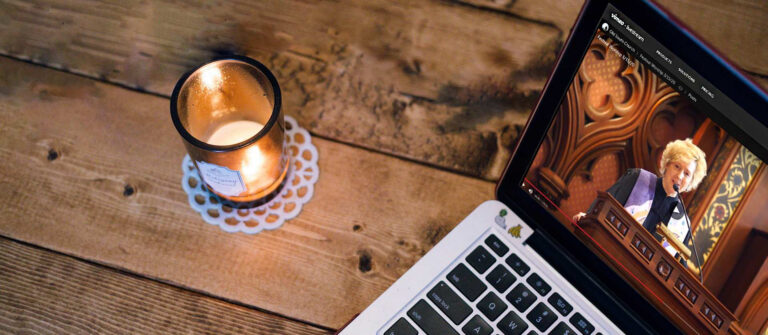
Church history is easier to access than ever, but that has not made every historical claim more reliable. A search for a pope, council, saint, doctrine, manuscript, or ancient church can lead to archives, university collections, blogs, videos, AI-written summaries, and social posts on the same screen. They do not carry the same evidentiary weight.
Treat online material as a starting point, not the final authority. Before accepting a surprising claim about Christianity’s past, check who published it, what evidence is cited, whether dates and quotations trace to original records, and whether reputable historians describe the event similarly.
Church history online often loses the context that makes facts meaningful

A date can be correct while the story built around it is wrong. A quotation can be authentic but removed from the controversy that gave it meaning. A council can be described as if it settled questions that were debated for decades afterward. Short-form content often compresses complicated developments into a sentence that sounds more certain than the evidence allows.
The internet also makes old errors easier to recycle. One article repeats another, a video repeats the article, and eventually the same claim appears in enough places to look established. Search visibility is not historical consensus.
AI adds another layer. The National Institute of Standards and Technology warns that generative AI can produce confidently stated false or erroneous information. If a church-history page looks mass-produced or unusually formulaic, ZeroGPT can be used as one screening tool for possible AI-generated text. It should not be treated as a truth detector. Human writers can be wrong, AI-written text can contain correct facts, and the historical claim still has to be checked against evidence.
This matters as digital church life becomes part of ordinary religious experience. Teaching, devotion, news, and historical commentary now appear in the same feeds, where spiritual reflection and historical research can easily blur together.
Start with the source behind the claim
When a post says “the Church decided,” “Christians always believed,” or “this was hidden for centuries,” the next question should be: according to what document? Historical work becomes stronger when readers move from a summary back toward the evidence it summarizes.
- Look for the author’s name, qualifications, publication date, and editorial organization.
- Check whether quotations identify the document, writer, council, letter, or edition they came from.
- Follow citations far enough to see whether they actually support the sentence making the claim.
- Be cautious when a dramatic conclusion depends on screenshots, unattributed quotations, or links that lead only to other commentary.
Research rule: A primary source is evidence from the past, but it is not automatic proof that every statement inside it is accurate. Authors had limited knowledge, motives, audiences, loyalties, and disputes of their own.
The Library of Congress primary-source analysis framework encourages readers to observe, reflect, question, and investigate further. The U.S. National Archives document-analysis guidance makes the same basic point: examining the document is the beginning of historical judgment, not the end.
Know what different sources can and cannot tell you
| Source type | Best use | Main caution |
| Primary source | Shows what a person, institution, or community recorded at the time | May be partisan, incomplete, later copied, or difficult to interpret |
| Scholarly secondary source | Explains evidence, context, chronology, and competing interpretations | Historians can disagree, especially when evidence is limited |
| Official church source | Useful for doctrine, institutional records, councils, papal texts, and current church explanations | An institutional perspective may not answer every historical debate by itself |
| Popular article or video | Good for orientation and discovering names, dates, and topics to research | Simplification can erase uncertainty or disagreement |
| AI-generated summary | Can help organize questions and terminology | Claims and citations require independent verification |
The point is not to distrust every nonacademic source, but to use each source for what it can establish. A parish history may preserve local details, while a devotional article may explain an event’s meaning to believers. Neither replaces archival research when the question is what happened and according to which records.
Use original documents when a claim is specific
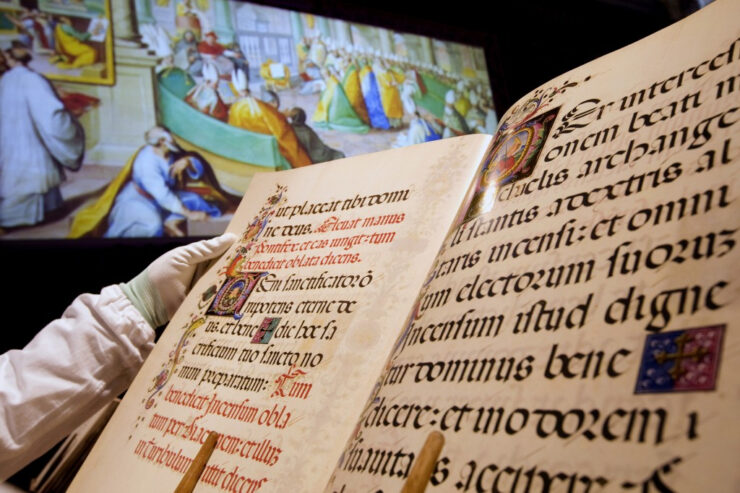
Church history is unusually rich in surviving texts: letters, creeds, council canons, homilies, legal records, papal documents, chronicles, liturgical books, manuscripts, and correspondence. Many are now available online.
The Vatican Apostolic Library provides online catalogues and access to digitized manuscripts, incunabula, archival materials, inventories, prints, coins, and other collections. Fordham University’s Internet Medieval Sourcebook also organizes translated primary texts, including church councils, writings of Church Fathers, saints’ lives, legal texts, and other medieval material.
Digital access does not remove basic questions. Who translated the text? Is it complete or excerpted? Is the date secure? Is the surviving version contemporary with the event or copied much later?
Watch for claims that turn long debates into one dramatic moment
One of the most common weaknesses in online church history is the “single meeting changed everything” story. Real institutional and theological history is usually slower.
The First Council of Nicaea is a good example. A Vatican document marking the council’s 1,700th anniversary identifies Nicaea in 325 as the first ecumenical council and explains that it produced the creed later completed at the First Council of Constantinople in 381.
That timeline alone shows why broad claims that every later Christian formulation was settled in one room in 325 need careful checking against the actual subjects, texts, and later developments.
A five-minute check can stop a bad claim from spreading

You do not need academic training to perform a basic verification. Before sharing a historical claim, try this sequence:
- Search the exact claim, person, document, or quotation rather than the broad topic.
- Find at least one institutional, archival, or scholarly source that addresses the same point.
- Compare the date, wording, and scope of the claim. Pay attention to words such as “may,” “probably,” “traditionally,” and “according to.”
- If sources disagree, do not flatten the disagreement. State what is established and what remains disputed.
- If the claim depends on a quotation, locate the fuller passage before using it.
A trustworthy account of church history makes the evidence visible. Strong articles distinguish faith claims from historical claims, primary testimony from later interpretation, and documented events from stories repeated so often that they begin to look factual.